Solo/Duo Multiple Choice

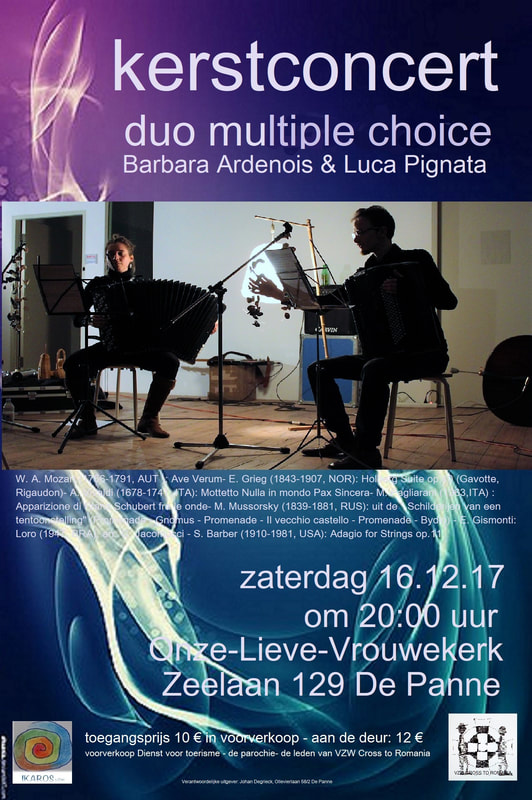
16/12/2017, DE PANNE (WV) (BEL)

Concert in the church of De Panne (Onze-Lieve-Vrouwekerk, Zeelaan 129), 20u

Works for accordion solo and duo from Baroque to Contemporary music, with Luca Pignata and Barbara Ardenois.

W. A. Mozart – Ave Verum
E. Grieg – Holberg Suite op.40 (Gavotte, Rigaudon)
A. Vivaldi – Mottetto Nulla in mondo Pax Sincera
M. Pagliarani – Apparizione di Franz Schubert fra le onde
M. Mussorsky – uit de ” Schilderijen van een tentoonstelling” (Promenade – Gnomus – Promenade – Il vecchio castello – Promenade – Bydło) 
E. Gismonti – Loro, arr. C. Jacomucci 
S. Barber – Adagio for Strings op.11 (1936) 


Solo/Duo Multiple choice

05/12/2017, (BEL)

Private concert with Luca Pignata and Barbara Ardenois (acc). 

E.Grieg – Holberg Suite op.40 (Gavotte, Rigaudon)
Maurice Ravel – Pavane pour une infante défunte (1899)
M. Mussorsky – uit de “Schilderijen van een tentoonstelling” (Promenade – Gnomus – Promenade – Il vecchio castello – Promenade – Bydło)
Egberto Gismonti – Loro
Astor Piazzolla – Tanti anni prima, Revirado
J. S. Bach – Fugue in g mineur voor orgel BWV 535
J. Ph. Rameau – Le Rappel des oiseaux
A. Vivaldi – Mottetto Nulla in mondo Pax Sincera
I. Stravinsky – The Rite of the Spring (Dance of the Young Girls)
S. Barber – Adagio for Strings op.11 (1936)

Accordion Workshop/Seminar – De Accordeon van Bal tot Bach

16/01/2017, INGELMUNSTER (BEL)

Ingelmunster – Vl@s, 14:30

Ontmoetingscentrum, Bollewerpstraat 3, 8770 Ingelmunster

Info: werner.blondeel@skynet.be

With Barbara Ardenois, Luca Pignata

History and organology of the accordeon, from the baroque to the contemporary music passing through the folk genres, the figure of Mogens Ellegaard, the relative instruments, the production of the sound. Solo/duo performance; music by Piazzolla, Bach, Gismonti, Zorn, Grieg

Toelichting

Vaak misprezen als trekorgel, trekzak, pens piano of ‘piano du pauvre’, is de accordeon langzaam maar zeker bezig aan een verdiend eerherstel, en dringt nu zelfs door tot in de klassieke muziek. Eindelijk is hij ook aanvaard in het officiële muziekonderwijs en de conservatoria. Hoog tijd dus om dit instrument te introduceren.
We horen accordeon nu ook meer en meer in onze directe omgeving: denk aan Mathias Lenz, het accordeon duo De Melando’s, Pop met Marino Punk en klassiek met Philippe Thuriot.

Als kers op de taart komt de Avelgemse Barbara Ardenois naar onze eigenste vereniging voor een gedegen kennismaking met alle facetten van de accordeon. Ze brengt ook haar vriend en accordeonvirtuoos Luca Pignata mee. Aan de hand van een powerpointpresentatie, afgewisseld met live muziek, zullen zij ons de accordeon met al zijn mogelijkheden beter leren kennen en waarderen.

Accordion Workshop/Seminar – De Accordeon van Bal tot Bach

19/01/2016, AVELGEM (BEL)

Avelgem Scheldeland – Vl@s, 14:00

Het Ganzenhof, Educatieve Bioboerderij – Bosstraat 2, 8580 Avelgem

Info: Dierk Dedeyne, 0476-950360, dedeyne.dierk@skynet.be


With Barbara Ardenois, Luca Pignata

History and organology of the accordeon, from the baroque to the contemporary music passing through the folk genres, the figure of Mogens Ellegaard, the relative instruments, the production of the sound. Solo/duo performance; music by Piazzolla, Bach, Gismonti, Zorn, Grieg


Toelichting

Vaak misprezen als trekorgel, trekzak, pens piano of ‘piano du pauvre’, is de accordeon langzaam maar zeker bezig aan een verdiend eerherstel, en dringt nu zelfs door tot in de klassieke muziek. Eindelijk is hij ook aanvaard in het officiële muziekonderwijs en de conservatoria. Hoog tijd dus om dit instrument te introduceren.
We horen accordeon nu ook meer en meer in onze directe omgeving: denk aan Mathias Lenz, het accordeon duo De Melando’s, Pop met Marino Punk en klassiek met Philippe Thuriot.

Als kers op de taart komt de Avelgemse Barbara Ardenois naar onze eigenste vereniging voor een gedegen kennismaking met alle facetten van de accordeon. Ze brengt ook haar vriend en accordeonvirtuoos Luca Pignata mee. Aan de hand van een powerpointpresentatie, afgewisseld met live muziek, zullen zij ons de accordeon met al zijn mogelijkheden beter leren kennen en waarderen.

Solo/duo concert

15/11/2015, KASTER (ANZEGEM) (BEL)

With Luca Pignata and Barbara Ardenois (acc.)

Music by Grieg, Pagliarani, Vivaldi, Ravel, Gismonti, Sørensen, De Machaut.

info@lucapignata.com

Arne Nordheim (1931-2010, NOR): Flashing

Nordheim’s music is meant to be very playful. His Flashing, originally the cadenza of his concerto for accordion and orchestra (Spur), became eventually his most famous work for accordion. The whole composition is based on a very frisky idea: the bouncing of a little ball. Nordheim discovered the stereophonic character of the accordion, from whose sound of the left and the right hand comes from different channels. This stereo sound capacity gave Nordheim the perfect opportunity to create the illusion of a bouncing ball.

Salvatore Sciarrino (*1947, ITA): Vagabonde blu (1998)

A very important page of the contemporary accordion literature, “Vagabonde blu” is a mirror of the aesthetics of the famous Italian composer: research of the noise brought to an extreme sensitiveness, dynamics rarely louder than a “piano”. It shows the physicality of the accordion as an instrument that breath like a lung, sighs and blow in the hands of the musician. “Vagabonde blu” are rare stars which appearance is different than the stellar evolution theory expects, maybe been originated by a collision between two stars.

I. Stravinsky (1882-1971, RUS): The Rite of the Spring (Dance of the Young Girls)

One of the most spectacular pages written by the Russian composer, characterized by a repetitive stamping bitonal chords combination, which Stravinsky considered the focal point of the entire work. The rhythm of the stamping is disturbed by Stravinsky’s constant shifting of the accent, on and off the beat, before the dance ends in a collapse, as if from exhaustion.

Chris Gendall (*1980, ZEL): Incident, Opera in one act (2012-14)

Synopsis:

In 1943, 48 Japanese Prisoners of War were killed in Featherston, New Zealand, after an incident from cross-cultural confusion and miscommunication. All events surrounding the incident were kept secret until well after the war had finished: the Prisoner-of-War camp’s existence was hidden from the New Zealand public, and the official military report on the incident was riddled with ambiguities.

The incident itself involved lining up 240 protesting prisoners in a relative small area within the camp, after a sit-in. Some nervous moments ensued, in wich prison huards allegedly suspected an inclement mutiny. The guards then opened fire, killing 48 Japanese, and injuring more – including 6 New Zealanders who were hit by wayward bullets.

Cast:

Guards: Donaldson-Baritone; Malcom-Tenor; Guard-Bass; Men’s chorus;

Prisoners: Adachi-Tenor; Men’s chorus

Lawyer-Countertenor

Instrumentation:

Flute, Oboe, Clarinet, Bassoon, Percussion, Accordion, Violin, Viola, Cello

Bent Sørensen (*1958, DAN): Looking on Darkness (2000)

Bent Sørensen, one of the most frequently performed contemporary Scandinavian composers, has taken the title, ‘Looking on Darkness’, from Shakespeare’s Sonnet No 27.

The thematic and intellectually clearly constructed form in which the inherent emotion is centrally placed, and which characterizes the sonnet, also forms the basis of Sørensen’s composition.

After a long day’s work the speaker of the sonnet from which the title of the work is taken lies looking out into the darkness; the memory of his beloved appears on his retina like a jewel in the night, but at the same time the sleepless one is restless at seeing the much missed beloved so clearly, and, just as in Shakespeare’s sonnet, the past, memory, arises in Sørensen’s music as it were out of nothing, out of the darkness, the silence; the concrete rattle of the accordion buttons and the sensitive dripping notes in the opening section vibrate on the borderline between the concrete and the hereafter.

Loss and mourning for that which is lost and will never come again, flow into the fleeting and poetic tones and meld together; the music oscillates, lingers, holds tightly to the absence, slackens its grip, tries again, does not say: hear me, but moves carefully onwards with itself like the fragmentary memories in Samuel Beckett’s late prose, before the sorrowful voice of the piece, just as beautiful and unobtrusive, withdraws again and leaves us to the silence, to what used to be.

Erland Kiøsterud