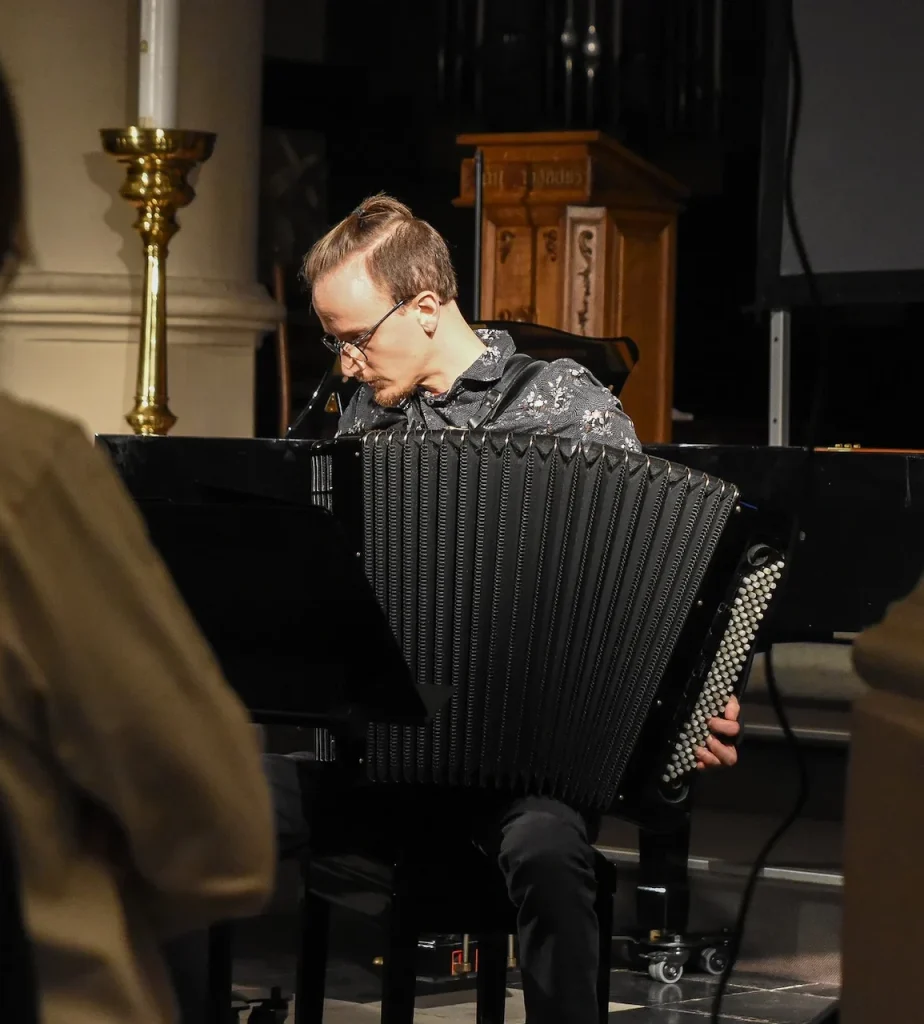
Jazz-folk-klassiek, eigen arrangementen van prachtige songs waaronder: Fields of gold, Gracias a la vida, Todo cambia, Alfonsina y el mar, Cancion Mixteca, Te cara a la pared, Água e vinho
VZW Warm Water – KultuurThuis Henri https://warmwater.be/
De Italiaanse accordeonist Luca Pignata, sinds 2014 actief in België en docent accordeon aan de academie van Waregem, keert terug naar Avelgem, waar hij eerder lesgaf aan het conservatorium. Hij opent het festival met de voorstelling van zijn nieuwe solo-album Traces: een boeiende muzikale reis langs de raakvlakken tussen klassieke muziek en volksmuziektradities uit onder meer Zuid-Amerika. Ook zijn accordeonleerlingen brengen een sprankelend optreden vol enthousiasme en spelplezier.
De leerlingen van accordeonleerkrachten Luca Pignata en Barbara Ardenois brengen als opwarmer van dit concert een sprankelend optreden vol enthousiasme en spelplezier: kom genieten van prachtige accordeonklassiekers van Franse musette over filmmuziek tot popklassiers door Arthur Buyck, Ronny Vermeulen, Dominique Tytgat, Lotte Kemseke, Stijn Van Haute, Herman de Bock, ensemble tieners en ensemble volwassenen.
Muziek van Scarlatti, Gismonti, Nazareth, Chiquinha Gonzaga.
I’m beyond excited to share with you the release of my new album “Traces” with music by Ernesto Nazareth, Egberto Gismonti, Domenico Scarlatti, Chiquinha Gonzaga, Carlos Gardel, Ariel Ramírez, and Lojze Lebič.
You can now listen to it at high quality on Bandcamp and on the other streaming platforms. If you decide to buy the digital album you will also be able to download a rich 25 pages long booklet where, besides the background and story of the music, I will share with you the process of approaching this repertoire and the beautiful artworks made specifically for the album by Tom Van Brugghe.
The release of the physical CD will happen in September.
This recording explores how folk and traditional idioms have been absorbed into composed music—often subtly, sometimes explicitly—tracing a path where oral heritage intersects with written form. The pieces presented here emerge from diverse cultural contexts, yet all reveal how local musical languages continue to shape concert-oriented composition.
In South America, the legacy of colonization and slavery gave rise to hybrid musical cultures. Enslaved Africans, forcibly brought to Brazil and Argentina by Portuguese and Spanish powers, preserved cultural memory through rhythm, melody, and dance. Despite suppression, these elements survived in rituals, celebrations, and everyday life. Over time, these genres entered the realm of composed music like in the works that I present of Ernesto Nazareth, Chiquinha Gonzaga, Ariel Ramírez and Egberto Gismonti.
Domenico Scarlatti’s sonatas, composed during his decades in Portugal and Spain, also reflect the influence of local traditions. Though rooted in Baroque keyboard technique, his music incorporates rhythmic features drawn from Iberian folk music. His keyboard writing is one example of how court composers absorbed regional soundscapes.
This dialogue between folk tradition and composed form continues in the 20th century with Rej by Slovenian composer Lojze Lebič which starts from two Slovenian folk songs and recontextualizes them within a modernist idiom for contemporary classical accordion.
Across centuries and continents, the boundary between folk and composed music has never been fixed. From Baroque dance suites to Gustav Mahler, Béla Bartok, and contemporary reinterpretations, composers have continually drawn on oral traditions to renew musical language. The pieces in this recording each contain such traces—sonic residues of an ethnic background and blur the line between tradition and classical composition.
This project would not have been possible without the generosity and insight of many friends. Vitor Goncalves introduced me with patience to the richness of Brazilian rhythm and helped me in the process of learning choro groove and articulation.Tom Van Brugghe created the paintings for the album. Janice Seynhaeve did the final editing to the text. Luca Piovesan did the mastering and was always present for any technical question. Lucia D’Errico did the elegant graphic design of the CD. In Alfonsina y el mar I play together with the gifted Belgian singer Naomi Sijmons in a touching rendition of this famous song.
Ik ben ontzettend blij om met jullie de release van mijn nieuwe album “Traces” te delen, met muziek van Ernesto Nazareth, Egberto Gismonti, Domenico Scarlatti, Chiquinha Gonzaga, Carlos Gardel, Ariel Ramírez en Lojze Lebič.
Je kunt het nu beluisteren op hoge kwaliteit op Bandcamp en op de andere streaming platformen. Als je ervoor kiest om het digitale album aan te schaffen, kun je ook een geïllustreerd boekje van 25 pagina’s downloaden. Daarin vertel ik niet alleen over de achtergrond en het verhaal van de muziek, maar neem ik je ook mee in het proces van hoe ik dit repertoire heb benaderd, dit samen met de prachtige kunstwerken die speciaal voor dit album zijn gemaakt door schilder Tom Van Brugghe.
De fysieke release van de CD vindt plaats in september.
Deze opname onderzoekt hoe volks- en traditionele stijlen zijn opgenomen in gecomponeerde muziek—vaak subtiel, soms expliciet—en volgt een spoor (“Traces”) waar mondeling erfgoed de geschreven vorm kruist. De werken die hier gepresenteerd worden, komen uit uiteenlopende culturele contexten, maar tonen allemaal hoe lokale muzikale talen de concertmuziek blijvend beïnvloeden.
In Zuid-Amerika leidde de erfenis van kolonisatie en slavernij tot hybride muzikale culturen. Tot slaaf gemaakte Afrikanen, die met geweld naar Brazilië en Argentinië werden gebracht door Portugese en Spaanse machten, wisten culturele herinneringen levend te houden via ritme, melodie en dans. Ondanks onderdrukking bleven deze elementen voortleven in rituelen, vieringen en het dagelijks leven. Mettertijd vonden deze genres hun weg naar de gecomponeerde muziek, zoals te horen is in de werken van Ernesto Nazareth, Chiquinha Gonzaga, Ariel Ramírez en Egberto Gismonti.
De sonates van Domenico Scarlatti, geschreven tijdens zijn decennialange verblijf in Portugal en Spanje, weerspiegelen eveneens de invloed van lokale tradities. Hoewel zijn muziek geworteld is in de barokke klaviertechniek, bevat ze ritmische kenmerken die afkomstig zijn uit de Iberische volksmuziek. Zijn klavierstijl is een voorbeeld van hoe hofcomponisten regionale klanken opnamen in hun werk.
Deze dialoog tussen volksmuziek en gecomponeerde vorm zet zich voort in de 20e eeuw met Rej van de Sloveense componist Lojze Lebič, die vertrekt van twee Sloveense volksliederen en ze hercontextualiseert binnen een modernistische taal, speciaal geschreven voor klassieke accordeon.
Eeuwen en continenten overschrijdend is de grens tussen volksmuziek en gecomponeerde muziek nooit vastgelegd geweest. Van barokke danssuites tot Gustav Mahler, Béla Bartók en hedendaagse herinterpretaties, componisten hebben voortdurend inspiratie geput uit mondelinge tradities om het muzikale idioom te vernieuwen. De stukken in deze opname bevatten elk zulke sporen—klankresten van een etnische achtergrond—en vervagen de lijn tussen traditie en klassieke compositie.
Dit project zou niet mogelijk geweest zijn zonder de gulheid en inzichten van vele vrienden.
Vitor Gonçalves liet me met veel geduld kennismaken met de rijkdom van het Braziliaanse ritme en hielp me bij het leren van de choro-groove en articulatie.
Tom Van Brugghe maakte de schilderijen voor het album. Janice Seynhaeve verzorgde de eindredactie van de teksten. Luca Piovesan deed de mastering en was steeds beschikbaar voor technische vragen. Lucia D’Errico ontwierp de elegante grafische vormgeving van de CD.
In Alfonsina y el mar speel ik samen met de geweldige Belgische zangeres Naomi Sijmons in een heel gevoelige interpretatie van dit bekend Argentijnse lied.
Joy. Prioritize yourself. Do what you like, what gives you meaning. Keep learning, playing, studying something new, going to concerts, if this gives you enthusiasm.
Playfulness. It is beautiful to learn something new, to do something we never thought we would ever be capable of, to discover a new talent in ourselves. Make it fun. Make it a game. Practicing shouldn’t be just a commitment but time we enjoy spending.
Once you can transmit the joy for music you can ask for more commitment and a more goal-oriented approach to music/studying/learning/results.
Listen to the desires of the students. What do they want to do? What brought them to learning music? What do they get from music? What motivates them? What music do they like to play? Be flexible, but don’t forget what you love and what gives you meaning.
Share what you do: what are you studying? Play for your students, show them your own process: it shows them that you accept challenges, and that you can fail too. Share with them what gives you enthusiasm.
Safety
Open/closed mode. Like the British actor John Clease (Fawlty Towers, Monty Python) said in a lecture: <<While we are creating there should be no fear of making a mistake and no time constraint. The essence of playfulness is openness to anything it may happen, a feeling that whatever happens, it’s OK. While we are creative, nothing is wrong.>> Once we have experimented enough we make decisions, we select what we want to keep and we then go into the closed mode where we work as efficiently and effectively as possible towards a concrete result.
If a child is always quiet in your lessons, there is something odd. Work on making them feel safe. You should not block their potentially high level of energy either. Instead, try to channel it (“organized chaos”) if you feel comfortable.
If necessary talk a lot to establish a good relation and the feeling of being in a safe space.
Work on rhythm: it takes time. Make and give time, play together, eventually simplify it or change medium (percussion, voice, dance). When there is no fear (of judgment, of doing it wrong, of making a mistake), if there are no neurological reasons, everybody should be able to consistently and precisely play relatively difficult rhythms. Again: create a safe space. Rhythm is not just feeling and freedom, it’s knowledge too.
Learning
Play a lot together with your students, it helps them in forming an auditory memory (of rhythm and articulation, for example) and in bringing the focus from 100% inward to partially outward, necessary for having a more objective feeling of time and pulse.
If you can, accept the challenges offered by your students. They want to explore a new musical genre? They would like to improvise or make their own music? Help them as much as you can. Experiment in these fields, even if they are out of your comfort zone. Working with children in these areas can be a simpler way to learn and explore.
There should be a bare minimum commitment, whether in terms of a daily or weekly amount of time dedicated to the instrument. Without regular practice, it is not possible to learn a musical instrument or truly enjoy playing it. Be clear about this with the student or their parents.
You cannot play something you can’t hear. Train the ears: listen to music, teach what to listen for in music
Repeat a lot: don’t stop when the student is capable of doing something, repeat until they feel comfortable with the task.
Strategy in practicing and not just brute force. Sometimes we can’t get to the result by facing the problem directly, we have to be creative and take a secondary path.
Study, dedicate hours, repeat. You will not learn if you don’t spend time practicing.
Some students need a lot of structure, some of them just need some inspiration. Most of them, however, want to know that you have a plan: never forget the important things you said in the last lessons, you should know or hear what the student has worked on. Sometimes, you are the only person who can give them the feeling, by appreciating their efforts and small weekly results, that they are moving forward.
Teaching is a learning process. Experience is the strongest learning environment but if you feel stuck, ask a colleague, you are not expected to know everything from the beginning.
When you feel stuck with a student, talk to them. But don’t problematize and talk too much: explaining something verbally is not the only way to help somebody understand.
With advanced students: listen a lot You will surely find something to say and offer them—maybe even just words of appreciation. If they follow lessons with you it’s because they value your opinion. If you can’t play what they do because you don’t have all the time in the world, or because you simply can’t, it’s not a problem, you can work with them on many other aspects of musicianship: broadening their horizons, refining specific techniques, listening to great examples, sharing your experience, or playing something from your own repertoire.
There are people that need a lot of instructions (due to insecurity and a need for control) before they feel comfortable and free, others who feel free by nature and/or cannot handle many instructions because it blocks them. It’s a spectrum, not ‘A or B’. Don’t force them to change, students don’t have to learn exactly the way you do. What you can do is expand their possibilities and help them become more flexible.
Technology will enrich your lessons. Useful tools include:
Transcribe! (for transcribing, transposing, and playing along in loops)
Various metronome apps with cool grooves (Soundcorset, eBatuque)
Recording apps
YouTube, Spotify
Fonometer (to visualize dynamics)
Musescore.org (to find scores) and Musescore (free) (to write scores)
iReal (for improvising and playing along)
Spectrometer (to see harmonics)
Learning is changing, changing is not easy. Authority is something you receive, not something that you demand. Don’t force change.
Give enough feedback, students want to know where they stand.
Listen. You don’t always have the answer—at least not right away. Sometimes, you need to take time to think about it (see the point about open/closed mode).
Learn to recognize and appreciate what is already good. As musicians, we often focus too much on what we cannot do or on what we can do better.
Challenges: finding the right moment and amount of challenge for the student is an art. It requires a lot of knowledge and empathy.
Don’t seek validation for your insecurities through your students’ performances. They don’t have to perform well for your ego. A performance where a student was forced to go beyond their limits due to fear of judgment is never positive. Even if the results appear good, they are coupled with feelings of fear and a lack of self-motivation. The long-term effects of such performances are negative. The student’s experience matters more than external perception. You cannot convince someone they did great if their own experience was awful.
It’s beautiful to see a student and reflect on how far they’ve come—growing as a musician and as an individual, becoming freer and more confident, and using music to express themselves.
This list is not meant as a guideline—it reflects my own process. It highlights what I felt I needed to work on and does not indicate the actual relevance of the different topics.
Some aspects, such as competence, curiosity, the desire to learn and improve, broadening horizons, self challenge, patient clarity and attention to detail, are very important to me even if I haven’t explicitly mentioned them.
Viaggiare con la musica Musiche di Piazzolla, Scarlatti, Gismonti, Nazareth, Gardel. Il fisarmonicista italiano Luca Pignata vi accompagnerà in questo viaggio musicale tra Europa e Sudamerica, tra Barocco e Novecento, con importanti storie di viaggi ed emigrazione.
(presentazione in Italiano)
Musiche di Ernesto Nazareth, Domenico Scarlatti, Egberto Gismonti, Carlos Gardel, Ariel Ramirez, John Dowland
Music by Bach, Scarlatti, Piazzolla, Gismonti et. al.
JS Bach – Preludium en fuga BWV 857 in f minor JS Bach – Preludium en fuga BWV 848 in c# major Carlos Gardel – El dia que me quieras, arr. Rodolfo Mederos Johann Pachelbel – Chaconne in f minor Astor Piazzolla – Vuelvo al sur, arr. James Crabb Domenico Scarlatti – Sonata K87 Ernesto Nazareth – Odeon JS Bach – Preludium en fuga BWV 535 in g minor Egberto Gismonti – Agua y vino, arr. Claudio Jacomucci Egberto Gismonti – Loro, arr. Claudio Jacomucci JS Bach – Corale Erbarm dich mein, o Herre Gott BWV 721
Musical intermezzo’s with Amalia Avilán (soprano).
Music by Manuel Ponce, De Falla, Fauré, Reynaldo Hahn, Bizet, Händel, Vivaldi, Tosti, Padilla Solo accordion: Mozart, Scarlatti, Purcell, Piazzolla, Gardel, French Musette’s
Musical intermezzo’s with Amalia Avilán (soprano).
Music by Manuel Ponce, De Falla, Fauré, Reynaldo Hahn, Bizet, Händel, Vivaldi, Tosti, Padilla Solo accordion: Mozart, Scarlatti, Purcell, Piazzolla, Gardel, French Musette’s